



Mitsubishi Electric is back at CEATEC 2026 in Japan with new AI-driven demonstrations showing how artificial intelligence could better understand its surroundings and assist humans in everyday life. Last year, we experienced the company’s Emoco Analytics Service, which used contactless sensors and AI to analyze people’s physiological states and emotions, demonstrating how intelligent environments could adapt to their occupants. This year, Mitsubishi Electric is exploring another dimension of physical AI: giving machines the ability to hear and distinguish sounds in complex environments.

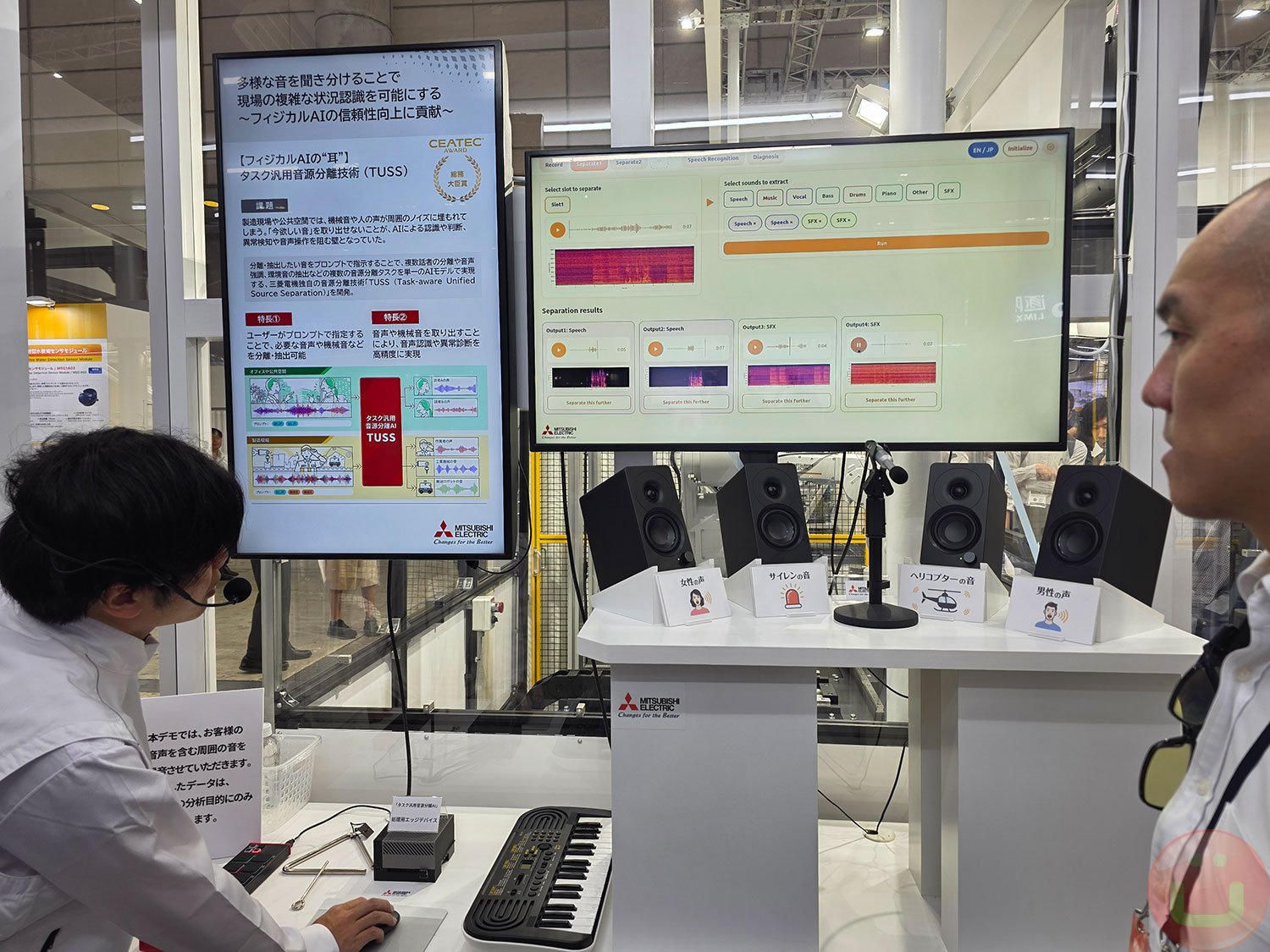
Task-Aware Unified Source Separation (TUSS) demo simulating noises during disater relief
TUSS Technology Gives Physical AI Better Hearing
On August 31, 2026, Mitsubishi Electric announced its Task-Aware Unified Source Separation (TUSS) technology, developed jointly with its research laboratories in Cambridge, Massachusetts.
The innovation lets a single microphone and a single AI model isolate specific sounds in a noisy environment. Unlike conventional sound separation technologies, which typically require dedicated AI models for different applications, TUSS can distinguish voices, machinery noises, and other acoustic signals by selecting which sound sources to extract.
The goal is to help physical AI systems, including robots, better understand their surroundings by complementing visual information with sound.
At CEATEC 2026, we attended a demonstration presented by a Mitsubishi Electric representative, who showed us two potential applications: disaster rescue operations and industrial equipment monitoring. TUSS is arguably the star of Mitsubishi Electric’s booth this year, having received the Minister of Internal Affairs and Communications Award at the CEATEC 2026 Innovation Awards.

Demo displays translated in English
Helping Rescuers Hear Survivors in Disaster Zones
In the first demonstration, the representative played a recording simulating an earthquake disaster, combining two human voices with other environmental sounds. The overlapping noises made the voices difficult to understand, even for Japanese speakers.
Using TUSS, the system separated the different sound sources from a single microphone recording, allowing the individual voices to be heard more clearly.
Mitsubishi Electric describes this challenge as removing “acoustic debris.” At disaster sites, heavy machinery, sirens, wind, rain, and radio communications can drown out faint voices calling for help. By instructing the AI to focus on human voices, the technology could provide rescuers with a “second ear,” helping them hear survivors and make better-informed decisions.

End of the demo: TUSS has detected anomalies using AI-driven sound separation
During our demonstration, Mitsubishi Electric representatives also explained the company’s vision of integrating this technology into rescue robots, allowing them to focus on detecting people calling for help in noisy disaster environments. This potential robotic application would complement the company’s broader objective of directly assisting human rescue teams.
Detecting Machinery Anomalies in Factories
The second demonstration focused on industrial applications. Factories are noisy environments where multiple machines operate simultaneously, making it difficult to identify abnormal sounds that could indicate equipment failures.
Mitsubishi Electric demonstrated how TUSS could separate machinery sounds, voices, and other acoustic signals from a mixed recording, potentially enabling AI systems to identify equipment problems.
The AI model is trained on isolated sound recordings combined into simulated mixtures, allowing it to learn to separate individual sources.
During our discussion, the spokesperson explained that Mitsubishi Electric plans to deploy the technology in its own factories in 2027 before offering systems to other manufacturers.
Visit the Mitsubishi Electric Booth at CEATEC 2026

At the Mitsubishi Electric booth, #8H412 in Hall 8, visitors can discover other AI innovations, including humanoid robots developed in collaboration with CP Robotics. Designed to restock shelves in convenience stores and supermarkets, these robots combine autonomous capabilities with remote human assistance when needed. A single operator could supervise multiple robots across different locations and take control when needed. These interventions also help train the robots to become more autonomous. Other exhibits highlight industrial automation and energy-efficient data center technologies.
We were particularly impressed by the broad range of Mitsubishi Electric’s AI developments, from giving machines better hearing and decision-making capabilities to automating complex industrial and retail tasks. Together, these demonstrations illustrate how the company is moving beyond conventional AI applications toward systems that can understand and interact with the physical world.
Mitsubishi Electric’s New AI Helps Rescue Robots Hear Survivors After Disasters
, original content from Ubergizmo. Read our Copyrights and terms of use.