





With top-tier color accuracy, refined design, Art Store access, and Vision AI Companion, the R95H stands out as one of Samsung’s most complete premium TV experiences.
Samsung introduced its RGB Micro LED TV technology at CES 2025. It later released a 115-inch commercial model priced at $29,999.99. At CES 2026, the company also showed a 130-inch R95H in a Timeless Frame design, which received one of Ubergizmo’s Best of Show Awards. Samsung is now launching its 2026 Micro RGB TV lineup in sizes from 55-inch to 115-inch, with the 100-inch model arriving later this year.

The new lineup includes two series: R95H and R85H. The main change is that Micro RGB is no longer limited to a giant $30,000 screen. It is now part of Samsung’s premium 4K TV range, in sizes much more practical for high-end home use. The current lineup includes 55, 65, 75, 85, and 115 inches, while the 100-inch size is scheduled to follow later. Pricing starts at $1,599.99 for the 55-inch R85H and goes up to $6,499.99 for the 85-inch R95H, with the 115-inch MR95F remaining at $29,999.99.
Samsung gave me an early look at several of its TVs at its New Jersey office, including the flagship Micro RGB R95H. Here are my first impressions.
Display Color Technology: 100% of the BT.2020 Color Area
Micro RGB uses thousands of micro-sized red, green, and blue LEDs, each under 100 μm, and each emits light independently. That is the key difference between Micro RGB and a typical LED-LCD or Mini-LED TV. A conventional LED TV starts with a white or blue backlight, then filters that light to create the final image. Micro RGB works directly with separate red, green, and blue light sources, which gives it more precise control over color output and reduces color bleed.
That is also why Samsung is putting so much emphasis on color purity. According to the manufacturer, the lineup reaches 100% of the BT.2020 color area, verified by VDE. This is the foundation of the Micro RGB argument: more precise RGB light control, wider color reproduction, and stronger color vibrancy than a conventional LED-backlit set.

New processors: Micro RGB AI Engine and Micro RGB AI Engine Pro
During our briefing, the representative explained that Samsung built a dedicated Micro RGB AI Engine for these TVs. Because the backlighting system uses independent RGB light sources, the processor must compute more than basic upscaling or scene recognition. It also has to manage how those red, green, and blue lights work together to build the final image. In the briefing, Samsung used a simple example: if a fire truck is mostly red with some white highlights, the processor has to tell the display how much red and how much white-like mix is needed to render it correctly.
Additionally, the new engine delivers Samsung’s Vision AI feature, AI Upscaling, which makes low-resolution content look significantly better.
That processing split also defines the lineup. The R95H gets Micro RGB AI Engine Pro wit AI Upscaling Pro, while the R85H gets Micro RGB AI Engine with AI Upscaling. Samsung also made clear in the briefing that the backlighting technology itself is the same across both series and all sizes. The difference is in processing and feature tier, not in a different display structure. The flagship R95H also adds Micro RGB Color Booster Pro, Micro RGB HDR Pro, and AI Motion Enhancer Pro, while the R85H uses Micro RGB HDR+. Both models support HDR10+ ADVANCED.

Micro RGB vs. OLED
OLED: better blacks and usually the most “infinite contrast” look because pixels can turn fully off. Because OLED is based on organic compounds (carbon-based, it has a burn-in risk that inorganic LED-based systems do not have in the same way.
Micro RGB: stronger on color purity, very high brightness, and vivid HDR highlights. The technical basis for that is the use of independent red, green, and blue micro-sized LEDs and 100% BT.2020 coverage. In the briefing, Samsung also described Micro RGB as delivering the highest level of color vibrancy in its TV lineup, compared with its OLED range. That does not make OLED less relevant. It means the two technologies are stronger in different areas. OLED is the more obvious choice for black levels and dark-room contrast, while Micro RGB is the more obvious choice for color intensity, high brightness, and HDR impact.
For instance, most high-end 4K OLED TVs already cover nearly all of the DCI-P3 color space used for HDR movies, but their BT.2020 coverage typically falls between 70% and 80%, though some QD-OLED models can go beyond that, which is why Samsung’s claim is notable.
Design – Very Good

The R95H includes Glare-Free and Wireless One-Connect Ready, while both the R95H and R85H support the Slim Fit Wall Mount and the Samsung Art Store.
The $4.99 monthly subscription to the Samsung Art Store includes access to more than 5,000 works. For users who do not want to break the bank, the company offers 30 free rotating pieces each month through Art Store Streams. This feature was previously exclusive to the Samsung Frame TV. Both Micro RGB series support Art Store, while the R95H features more premium hardware extras.

The bezel-less 65-inch R95H model I saw was mounted on an Infinity Air stand, which is almost invisible. The device profile is impressively thin for its size. Combined with the Glare-free finish, the Slim Fit Wall Mount helps the screen work well as a display for artwork from the Art Store, giving it a more art-piece feel when it is not being used as a TV.
Image Quality – Excellent
During the demo session, I watched a range of content, including broadcast TV, Netflix shows, artwork from the Art Store, and various 4K YouTube videos. Overall, the picture quality was excellent, with vivid colors and high brightness throughout. The artwork rendering was convincing enough to give the screen the feel of a real painting when the TV was not in use.
In my viewing, the flagship S95H OLED and this Micro RGB set were comparable in overall image quality. The stronger color accuracy could make the R95H especially appealing to art enthusiasts. OLED remains the more obvious choice for movie lovers watching in a dark room, while Micro-LED would be the better fit for brighter rooms, though its high brightness handles lowlight environments well.
Gaming – Very Good

Samsung is also giving these TVs real flagship gaming specs. The R95H reaches Motion Xcelerator 165Hz, while the R85H reaches Motion Xcelerator 144Hz, both supporting VRR. In the briefing, Samsung noted that both refresh rates are already well above what most console users need, but they still place Micro RGB firmly in premium TV territory.
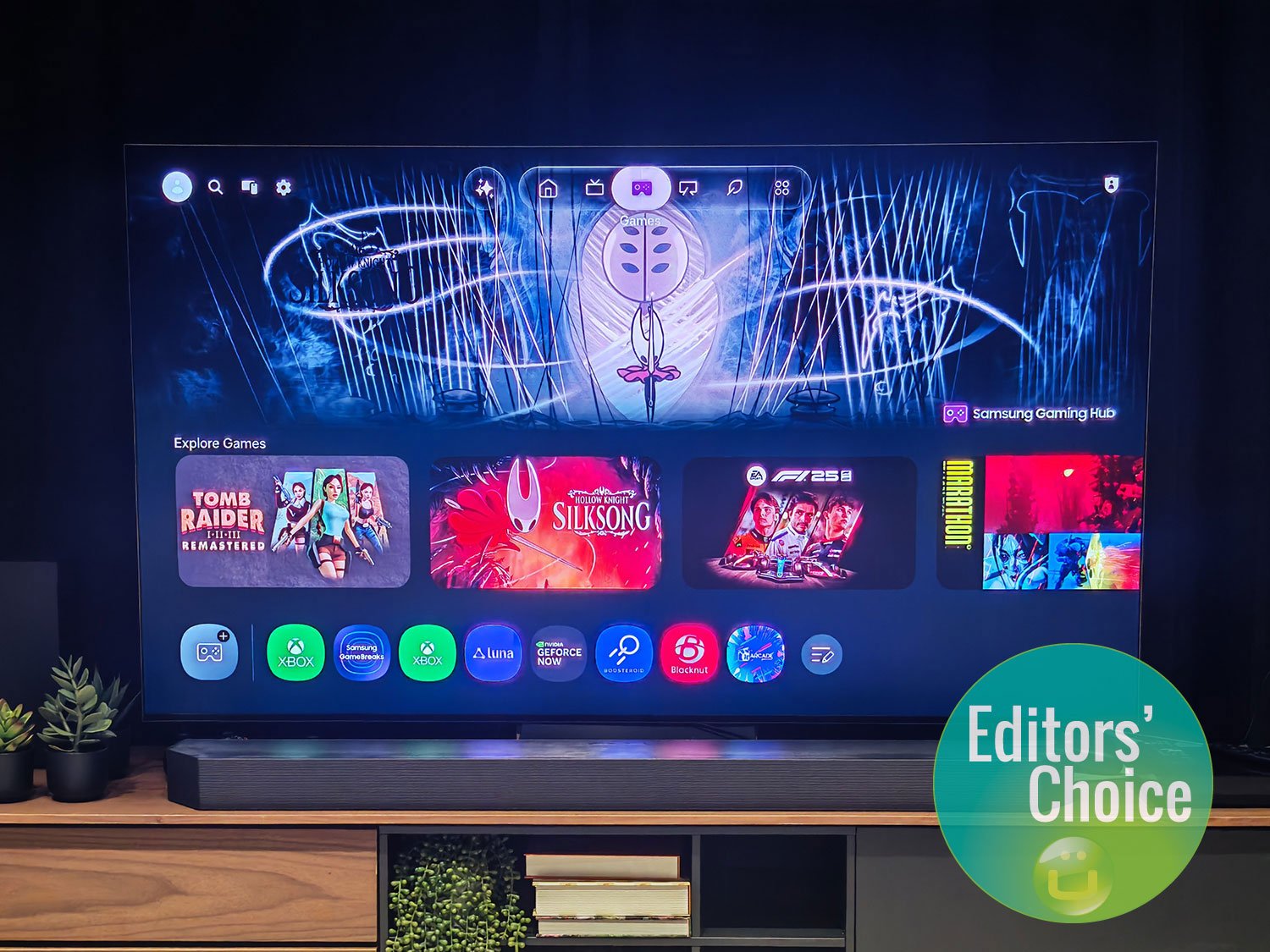
The Samsung Gaming Hub is a console-free, cloud gaming interface that provides access to a broad range of game streaming services, including Xbox Game Pass, NVIDIA GeForce Now, and Amazon Luna. It also allows for easy connection to physical consoles via HDMI.
I did not test the gaming features this time, but the high refresh rates and Variable Refresh Rate (VRR) support look promising for delivering a strong gaming experience when the TV is connected by wire. Competitive gamers will still prefer dedicated gaming monitors paired with the most powerful systems available, but these features should be very appealing for gaming enthusiasts.
Audio
Audio is a bigger part of the package than the display demo alone suggested. The lineup includes Dolby Atmos, Object Tracking Sound, and Q-Symphony support with up to five Samsung sound devices. That makes these sets easier to place in a full Samsung home theater setup rather than treating them as standalone display products.
I could not experience the built-in audio because the TV was paired with the newly launched HW-Q990H soundbar, which delivered powerful, clear sound.
Excellent New User Interface, Vision AI Companion, and New Features
Samsung redesigned its Tizen Smart TV interface by moving the navigation menu from the left side to the top and making AI features easier to access. The new navigation system feels more fluid and easier to use, while preserving most of the screen for current content, icons, and widgets.
Vision AI Companion and Dashboard

Micro RGB is also one of Samsung’s main showcases of its 2026 Vision AI software features, available now on all-new Samsung TVs. The most practical change is that Samsung now puts its AI tools in a dedicated Vision AI dashboard, rather than burying them in settings menus.
This change was implemented based on user feedback, who often did not know where the AI features were or how to access them, so the new interface puts them in one place on the home screen and on the remote.

Samsung unveiled its Vision AI Companion last September at IFA 2025, which brings a built-in interface for a large language model to the TV. It supports natural-language questions, follow-up questions, and contextual understanding. The transcript makes clear that this is meant to work like other LLM interfaces people already know from phones and laptops, except now it is available directly on the TV.
In its Vision AI Dashboard, Samsung is also adding separate apps for Microsoft Copilot and Perplexity, rather than forcing everything through a single assistant.
The new AI interface is much more compelling than last year’s. It was very easy to use Samsung Vision AI Companion: I clicked the AI icon at the top of the screen, then I spoke into the remote to ask a question. The AI responded by displaying its answer in text along with a few videos related to the topic.

I asked questions about museums, Egyptian artifacts, and George Washington. Both Samsung Vision AI Companion and the Perplexity app returned text and video responses, while Copilot provided audio responses only, except for weather, where it also displayed visual information.
Other AI-powered features include Live Translate for broadcast, cable, and Samsung TV Plus in up to 12 languages, as well as Generative Wallpaper. I tried the generative wallpaper feature, and it is a fun way to create your own images using a few mood-based keywords.

AI Soccer Mode Pro and AI Sound Controller Pro
Samsung is also adding AI Soccer Mode Pro and AI Sound Controller Pro on the R95H. AI Soccer Mode boosts field and jersey colors and makes game audio more immersive, while AI Sound Controller lets users independently adjust voices, music, and sound effects. In practice, that means users could reduce or even mute commentators, leaving crowd noise or stadium sound more prominent.
One UI Tizen OS
The lineup runs Samsung’s updated One UI Tizen, with up to seven years of OS updates, Samsung TV Plus, and support for the Gaming Hub.
Pricing
Samsung is pricing the new Micro RGB range well below the earlier 115-inch $29,999.99 model, with the R95H serving as the premium series and the R85H as the more accessible entry point. The R95H starts at $3,199.99 for the 65-inch model, rises to $4,499.99 for the 75-inch model, and reaches $6,499.99 for the 85-inch model. The R85H starts at $1,599.99 for the 55-inch model, then moves to $2,099.99 for 65 inches, $2,799.99 for 75 inches, and $3,999.99 for the 85-inch model.
Samsung Micro RGB 2026 TV Lineup: Flagship R95H Hands-On Review
, original content from Ubergizmo. Read our Copyrights and terms of use.